Este artigo está disponível apenas em inglês.
Four hours is enough to reach Lisbon from Cascais, drink a coffee, walk through two historic districts and see the Tagus—but only if you resist the temptation to cross the whole city. This guide sets realistic expectations for a half day Lisbon from Cascais, suggests a compact Lisbon half day itinerary, and compares the train with a private car tour when convenience or a flexible pace matters.
How much of Lisbon fits into four to six hours?
The first question is whether your four-to-six-hour window includes travel from Cascais. It usually does, and that changes the plan considerably. The train journey between Cascais and Cais do Sodré generally takes around 40 minutes, although you also need time to reach the station, buy or validate tickets, wait for the train and allow a margin for the return. A nominal four-hour outing may leave little more than two hours in central Lisbon. With six hours, you can usually enjoy three to four hours in the city without watching the clock every five minutes.
That is enough for a satisfying introduction, not a miniature version of a full Lisbon holiday. Pick one connected area and let yourself notice it properly. Baixa and Chiado work particularly well because they sit close to Cais do Sodré, offer several recognisable Lisbon sights and do not require long transfers between stops. Trying to add Belém, Alfama and Castelo de São Jorge turns a short visit into a transport exercise. You may technically reach everything, but you will spend the day moving rather than experiencing the city.
A good half-day in Lisbon should feel like one coherent walk, not five famous places joined by hurried taxi rides.
A compact Lisbon half day itinerary that actually works
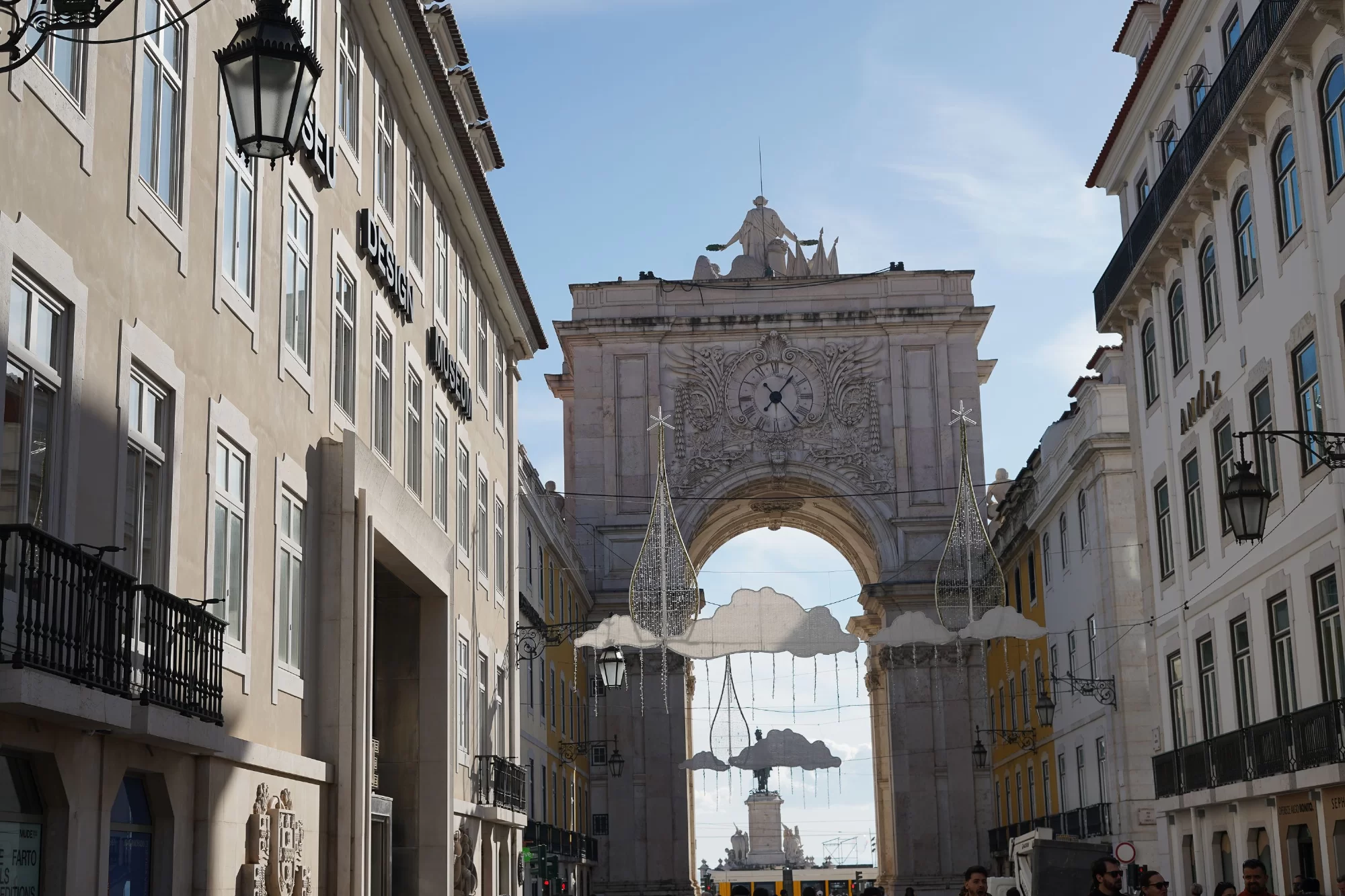
From Cais do Sodré, walk east along the riverfront towards Praça do Comércio. This opening stretch immediately gives you a sense of Lisbon's relationship with the Tagus, and the broad square provides the grand architectural moment most first-time visitors want. Pass beneath the Arco da Rua Augusta and continue into Baixa. The grid of streets here is relatively easy to navigate, which matters when every wrong turn eats into a short schedule.
Follow Rua Augusta towards Rossio, but do not treat it as a race. Side streets reveal tiled façades, traditional shopfronts and small pastry counters where a standing coffee is quicker—and often more atmospheric—than a long café stop. Around Rossio, pause to take in the patterned paving and the surrounding buildings. From there, climb towards Chiado. The incline is noticeable, though manageable for most visitors who are comfortable walking. If someone in your group has reduced mobility, this is where a private car itinerary becomes more useful.
In Chiado, choose one final stop rather than three. Largo do Carmo is the strongest option for a short visit: it has shade, a calmer atmosphere than the shopping streets and views of the roofless Convento do Carmo. Entering the museum can be worthwhile, but only if your schedule has room for it. Otherwise, enjoy the square and descend towards Cais do Sodré. The complete route is compact enough to walk, yet varied enough to show Lisbon's riverfront, formal squares, downtown streets and hillier historic character.
Muito do que torna isto complicado desaparece quando não é você a conduzir nem a navegar — é basicamente para isso que serve um transfer privado.
Organizar um transfer →- For a four-hour outing: keep the route to Cais do Sodré, Praça do Comércio, Rua Augusta and Rossio, then return directly.
- For a five-hour outing: add Chiado and Largo do Carmo, with one quick coffee or pastry stop.
- For a six-hour outing: follow the full route at a gentler pace and allow time for a light meal or one interior visit.
Taking the train for a half-day Lisbon visit
The train is the sensible default for independent travellers. Cascais station is central, the route runs along the coast and the Lisbon terminus at Cais do Sodré places you beside the Tagus and within walking distance of Baixa. You avoid parking, central traffic and the uncertainty of finding a legal place to stop. For one or two reasonably mobile adults, it is usually the clearest and most economical choice.
Check the current timetable before leaving and identify a return train that gets you back with a comfortable margin. Do not build your plan around catching the last possible service before a dinner reservation, airport transfer or fixed activity. A missed train, a longer lunch or a queue at a monument can quickly create stress. It is also wise to keep the final part of the route near Cais do Sodré rather than ending at the top of a distant hill.
The train has limitations. It is not door to door, and crowded periods can be tiring with a pushchair, luggage or a family group. Central Lisbon's paving is beautiful but uneven, while the climb from Baixa to Chiado can be demanding for anyone with knee, balance or stamina concerns. In those cases, the cheapest transport is not necessarily the best use of a limited half-day.
When a private Lisbon tour from Cascais makes sense
A private Lisbon tour from Cascais is most useful when time matters more than cost. Collection from your accommodation removes the walk to the station and the waiting time, while a driver or guide can adjust the route if traffic, weather or mobility changes the plan. This does not guarantee a faster journey—Lisbon traffic can be slow—but it makes the outing simpler from door to door.
O transporte porta a porta elimina grande parte das dificuldades descritas acima — vale a pena se viaja com bagagem ou com pouco tempo.
Reservar transfer →The main advantage is not seeing twice as much. It is choosing a pace that suits your group. A family with young children might shorten the walking sections and spend longer by Praça do Comércio. Travellers with limited mobility can be dropped near key areas and avoid the steepest connections, subject to traffic restrictions and suitable stopping points. Someone interested in architecture may prefer Baixa and Chiado, while a first-time visitor who values views over shopping could ask for a carefully selected viewpoint instead.
A private car also becomes more attractive if you have exactly four hours and must return by a fixed time, or if several people are sharing the cost. Even then, keep the itinerary restrained. Asking a guide to include central Lisbon, Belém, Alfama and the castle in one short tour produces little more than a sequence of passing windows. A customised pace should create breathing room, not provide an excuse to overload the route.
What should you leave for another day?
Belém deserves more than a rushed detour. Its monuments, riverside setting and popular pastry stops can absorb most of a half-day on their own. Alfama is equally unsuited to a quick add-on: its steep lanes are better explored slowly, and driving through the district cannot reproduce the experience of walking it. Castelo de São Jorge often involves extra travel and possible queues. Save all three for a longer Lisbon visit rather than treating them as boxes to tick.
Lunch is another common time trap. A leisurely Portuguese meal can easily become the main event, which is perfectly valid if food is your priority. If sightseeing matters more, choose a bakery, small lunch counter or uncomplicated café in Baixa or Chiado. Avoid crossing Lisbon for a restaurant you saw online. On such a short visit, location matters more than having the city's most discussed plate.
Se ainda está a decidir como lá chegar, um transfer privado reservado com antecedência resolve essa decisão por si.
Ver opções de transfer →Cycling also needs an honest recommendation. Renting a bike is normally one of the best ways to explore around Cascais, but taking one into central Lisbon for this particular half-day adds train logistics, tram tracks, cobbles and steep streets to an already tight schedule. Walking from Cais do Sodré is better. If you want an active day, combine the short Lisbon visit with a separate ride after returning to Cascais; a rental from Tomorrow's Adventure at Cascais Train Station fits more naturally there than forcing a bicycle into Baixa and Chiado. Alternatively, devote another day to a purpose-built Lisbon riverside ride rather than mixing cycling with a rushed historic-centre circuit.
Is half a day in Lisbon enough for you?
Go if you are comfortable seeing one slice of the capital. A first look at the Tagus, Praça do Comércio, Baixa and perhaps Chiado can be memorable, especially if Lisbon is not otherwise part of your trip. Skip it if your ideal visit includes major monuments, long meals, museums and several neighbourhoods. Four hours rewards discipline; six allows a little spontaneity.
For most independent visitors, the train and a compact walking loop are the right combination. Choose a private car tour when door-to-door travel, mobility support or a tailored pace will materially improve the day. Whichever option you take, judge success by how well you experienced a small part of Lisbon—not by how many names you managed to fit into the schedule.