Este artigo está disponível apenas em inglês.
Lisbon’s best-known viewpoints can sit only a kilometre apart on the map yet feel much farther away once cobbles, gradients and tram tracks enter the picture. This accessible Lisbon itinerary links several rewarding views while reducing steep walking, explains where surfaces may still be awkward, and compares public transport with using a private driver-guide. It is designed for travellers who can manage a little walking but want to avoid turning the day into an endurance test.
What low-walking really means in Lisbon
There is no completely step-free chain of historic Lisbon viewpoints. Even where a vehicle can stop nearby, the final approach may involve uneven paving, a sloping pavement, a high kerb or a short stretch of polished calçada. Benches can be occupied, temporary works can narrow a route, and traffic restrictions may change where taxis and private vehicles are allowed to wait. Treat “Lisbon viewpoints without walking” as useful shorthand for minimising distance and climbing, not as a promise that every stop is flat.
The most comfortable plan is to choose three main viewpoints rather than collecting every miradouro in the city. Allow time to sit, take photographs and recover between stops. A rushed itinerary creates its own mobility problem: tram queues grow, pavements become busier, and the temptation to take a steep shortcut increases. Morning generally gives you more breathing room, particularly at viewpoints close to the historic centre.
A good low-walking day in Lisbon is measured by the views you enjoy, not by the number of hills you conquer.
Before setting out, consider what “limited mobility” means for you or your companion. Someone using a folding walking stick has different needs from a wheelchair user, while fatigue, balance difficulties and joint pain may make cobbles more challenging than distance. If a wheelchair or larger mobility aid is involved, confirm vehicle space and current access at each stop rather than relying on a general description online.
A practical route through Lisbon’s easier viewpoints
Begin at the upper end of Parque Eduardo VII. The view runs downhill over the formal gardens towards Praça Marquês de Pombal, Avenida da Liberdade and the Tagus beyond. Starting at the top avoids the long climb through the park. A vehicle can usually bring you much closer to the viewing area than the metro, although the final surface and exact stopping point should be checked on the day. The broad setting also feels less compressed than the narrow lanes around Lisbon’s oldest quarters.
Continue to Miradouro de São Pedro de Alcântara, overlooking Baixa, the eastern hills and Castelo de São Jorge. This is one of the strongest choices for a reduced-walking route because the view is reached from an established terrace beside a road rather than from the end of a long pedestrian staircase. That does not make it perfectly level: paving can be uneven, the terrace has changes in level, and crowds may make manoeuvring harder. Still, it offers a classic Lisbon panorama without demanding a major uphill approach if you arrive by vehicle.
O transporte porta a porta elimina grande parte das dificuldades descritas acima — vale a pena se viaja com bagagem ou com pouco tempo.
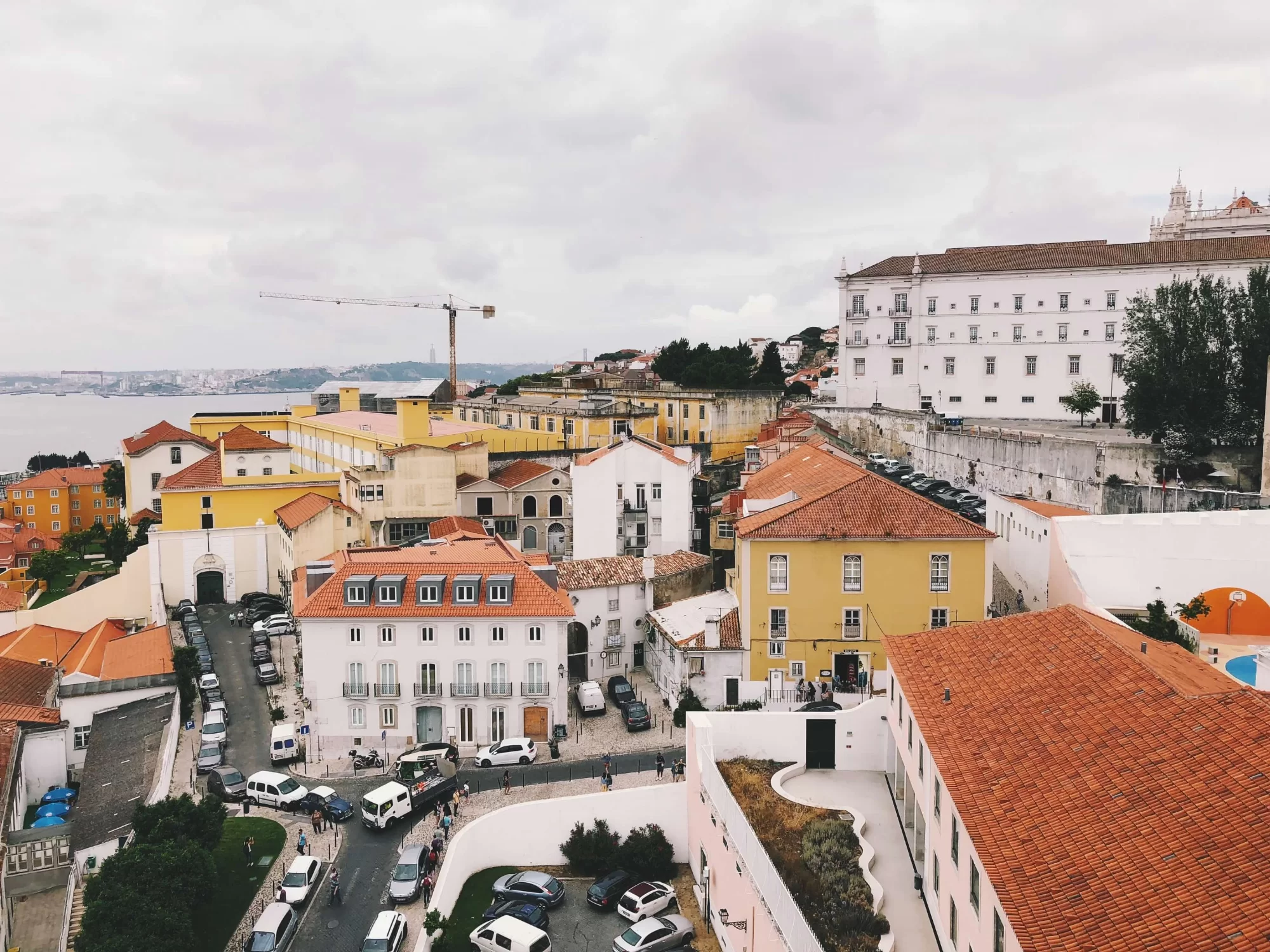
Reservar transfer →Your third main stop should be Miradouro das Portas do Sol. From here, the rooftops of Alfama descend towards the Tagus, with church towers and pale façades filling the foreground. The viewpoint itself is popular and can become congested, while the surrounding streets include tram rails, cobbles and irregular pavements. A driver-guide can manage the closest practical drop-off permitted that day. If you are using public transport, leave extra time and avoid assuming that the nearest tram will provide easy boarding.
- Parque Eduardo VII: the most open stop, best approached from the upper side rather than climbed from Praça Marquês de Pombal.
- São Pedro de Alcântara: the best central panorama for many visitors seeking a short final approach.
- Portas do Sol: the most atmospheric historic view on this route, but also the one where crowds and uneven ground need the most patience.
Should you add Senhora do Monte?
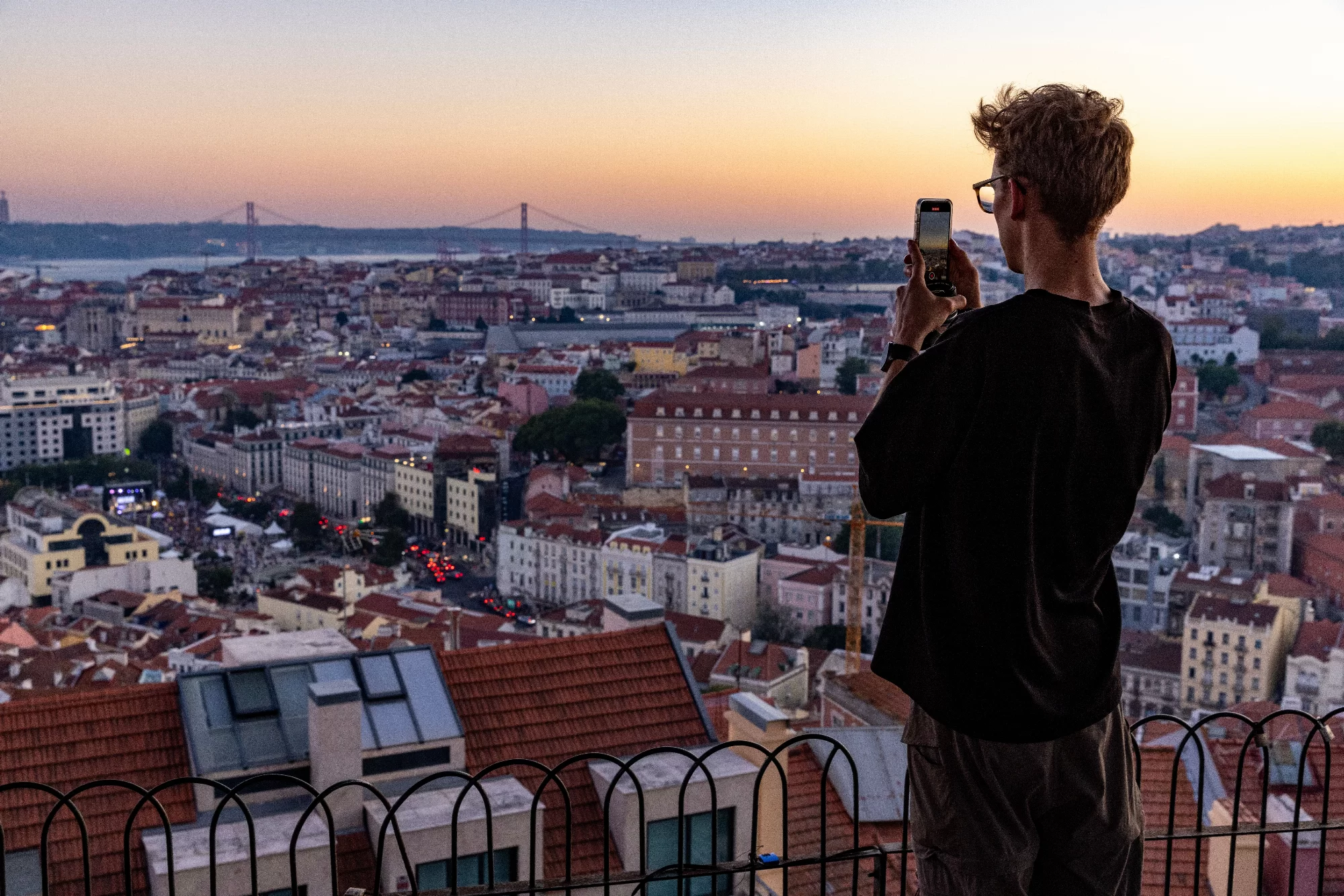
Miradouro da Senhora do Monte has one of Lisbon’s widest panoramas, stretching across the city towards the castle, central districts and river. It is tempting to label it essential. For a low-walking day, however, it should be optional rather than automatic. The viewpoint sits high in Graça, and the surrounding slopes are exactly the sort of terrain this itinerary is trying to reduce.
With a private vehicle and a suitable nearby stopping point, Senhora do Monte may be manageable for somebody who can cover a short uneven approach. By public transport, the remaining walk can still feel demanding, especially in heat or after several earlier stops. It also becomes busy around sunset. If energy is fading, keep the three-stop route and enjoy it properly instead of forcing a final hill for one more photograph.
Another sensible option is to pause in central Lisbon between São Pedro de Alcântara and Portas do Sol. A relaxed lunch in Baixa gives tired legs a genuine break and provides access to flatter streets than those around Graça or Alfama. Choose a restaurant with an entrance you can inspect easily; older Lisbon buildings often have a step at the door or toilets reached by stairs, even when the dining room appears accessible from outside.
Public transport saves money but not always effort
Lisbon’s metro, buses, trams and funiculars can remove a large amount of climbing, but they do not join these viewpoints into one seamless accessible route. Parque Eduardo VII is served by transport around Praça Marquês de Pombal, yet reaching the upper viewpoint from below means negotiating the park’s incline. For São Pedro de Alcântara, the Glória funicular is the obvious map solution from near Restauradores, but service interruptions, queues, boarding conditions and the steep streets around each end make it unwise to depend on without checking current operations.
Muito do que torna isto complicado desaparece quando não é você a conduzir nem a navegar — é basicamente para isso que serve um transfer privado.
Organizar um transfer →Historic trams are part of Lisbon’s character, but older vehicles can be difficult for travellers with reduced mobility. Steps may be high, interiors tight and stops crowded. A bus may offer a more practical connection to some elevated districts, although vehicle type, boarding space and stop accessibility can vary. Metro stations are not identical either: lifts may be out of service, and changing lines can involve more corridor walking than expected.
If budget matters and you can tolerate short stretches on foot, combine public transport with occasional taxis or ride-hailing vehicles. For example, use the metro for the broad journey into central Lisbon, then take a car uphill for the final connection. This hybrid approach is usually more comfortable than insisting on public transport for every leg. Keep the route on your phone, but ask the driver to confirm the closest legal and practical drop-off rather than requesting a viewpoint name and assuming the door will open directly onto the terrace.
Why a private driver-guide can be the easier choice
A private driver-guide is the clearest option for linking dispersed Lisbon viewpoints with the least physical effort. The advantage is not simply door-to-door travel. A good driver can adjust the order around traffic, identify a safer side of the road for exiting, wait while you take a slow approach and remove a stop if fatigue or weather changes the plan. That flexibility matters more than covering a long list of landmarks.
Discuss mobility requirements before the day begins. Explain whether you need space for a wheelchair or rollator, whether high vehicle steps are difficult, and how far you can comfortably walk on cobbles. Ask whether the driver remains with the vehicle or accompanies you to each viewing terrace; “private tour” can describe different service styles. It is also sensible to request regular toilet and seated refreshment breaks, since viewpoint facilities are inconsistent.
A driver-guide costs more than buses and metro journeys, but for two or more travellers the comfort difference can justify the expense. It is particularly helpful for people whose energy varies during the day, families travelling with an older relative, or anyone who cannot stand for long in a transport queue. The route can also finish early without the complication of finding a suitable connection from a hilltop district.
Se ainda está a decidir como lá chegar, um transfer privado reservado com antecedência resolve essa decisão por si.
Ver opções de transfer →Where cycling fits into this particular Lisbon day
Cycling is often the best way to explore Lisbon’s flatter Tagus waterfront, especially around broad riverside areas where you can set your own pace and stop without waiting for transport. A well-fitted e-bike can also soften gradients for confident riders. This viewpoint route is different. Tram tracks, steep streets, traffic, cobbles and repeated mounting and dismounting make it a poor match for many travellers with limited mobility. An e-bike assists pedalling; it does not make a heavy bicycle easier to balance, push or control on an uneven descent.
If your mobility needs are mild and you already ride confidently in cities, consider separating the experiences. Use a bicycle for a flatter riverside outing on another part of your stay, then tackle the elevated viewpoints by public transport or private vehicle. Do not choose a bike solely because the viewpoints look close together on a map. Lisbon’s contour lines matter far more than the straight-line distance.
Bring supportive shoes even if most connections are by car, carry water in warm weather, and keep the day flexible. Parque Eduardo VII, São Pedro de Alcântara and Portas do Sol provide three distinct views: a formal green axis, a broad central-city panorama and the tiled roofs of historic Alfama. That is enough to understand Lisbon from above without spending the day battling its steepest hills.